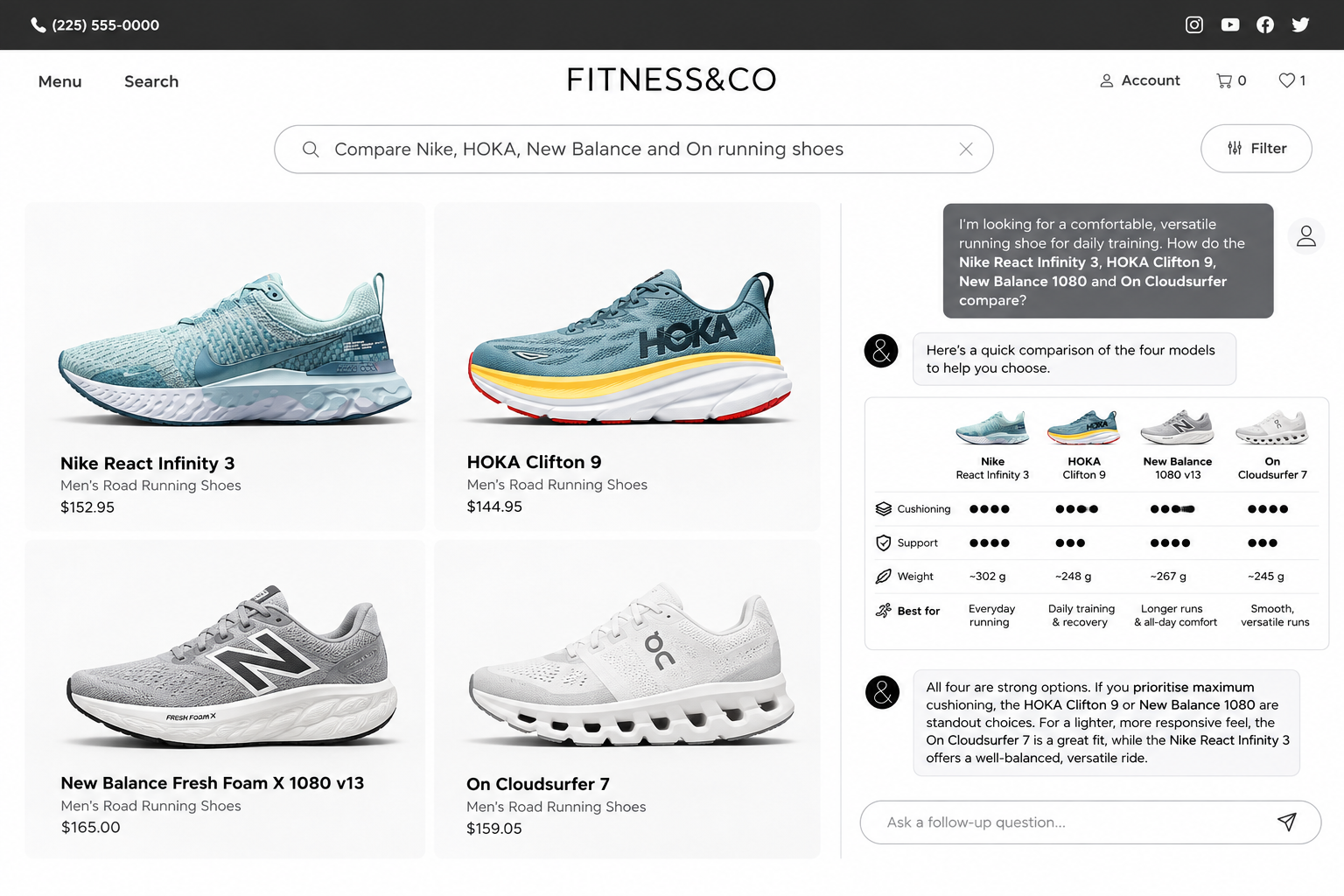
For ecommerce leaders, this creates a new competitive challenge: being visible when consumers are deciding what to buy, not just when they begin searching.
AI is becoming part of the buying decision
Consider how someone might shop for a new pair of running shoes.
A traditional search journey might begin with “best running shoes UK”, followed by visits to retailer websites, product reviews and comparison pages.
An AI-assisted journey can look different. A shopper might ask:
“What’s the difference between the Nike Pegasus and ASICS Gel-Nimbus for everyday running?”
They might then ask:
“Which would be better for someone running 30 kilometres a week?”
And finally:
“Which UK retailers sell the recommended model, and what should I check before buying?”
The shopper is no longer simply discovering products. They are using AI to evaluate alternatives, understand trade-offs and build purchasing confidence.
Research supports the growing importance of this behaviour.
McKinsey reported in April 2026 that 63% of surveyed European consumers used AI-powered tools to compare options such as brands, models, prices and reviews.
These findings point towards an important change: AI is becoming an influential layer within the shopping journey, even when the final transaction happens elsewhere.
From product discovery to purchase consideration
AI-assisted shopping involves several distinct consumer needs.
| Shopping stage | Example consumer question | What matters to retailers |
|---|---|---|
| Discovery | “What are the best everyday trainers?” | Product and brand visibility |
| Comparison | “Nike Pegasus vs ASICS Gel-Nimbus?” | Inclusion in relevant product comparisons |
| Evaluation | “Which is better for long-distance running?” | Product relevance, evidence and recommendation quality |
| Validation | “Are these shoes durable and worth the price?” | Reviews, accurate information and credibility |
| Purchase consideration | “Where can I buy these in the UK?” | Retailer visibility, pricing and availability |
These stages are not always linear.
Consumers may move backwards, ask follow-up questions or verify AI recommendations using search engines, retailer websites and independent reviews.
The important change is that AI can influence several stages of evaluation within a single conversation.
Two roles with particular commercial relevance
- The Buying Advisor
- AI helps consumers compare products, assess features, evaluate trade-offs and narrow their options. This is especially relevant to footwear, fashion, accessories, electronics and other categories where shoppers must choose between competing products.
- The Planning Advisor
- AI helps consumers organise more complex purchases or experiences, including travel, dining and event planning. For retailers, this can create product discovery opportunities around specific occasions and needs — for example, a consumer planning a hiking holiday might ask for suitable waterproof footwear, clothing and accessories.
In both cases, AI can influence which products enter the consumer’s consideration set.
The new competitive risk: Being excluded before the first website visit
For years, digital marketing teams have focused heavily on rankings, impressions, clicks and conversions. Those metrics remain essential.
But they do not provide a complete picture of how a brand or product is represented inside AI-generated shopping responses.
Imagine two footwear retailers competing for the same customers. Both stock a popular running shoe. Both have functioning ecommerce websites. Both invest in organic and paid search.
Yet when shoppers ask an AI assistant for recommendations, one retailer is consistently included in the sampled responses while the other rarely appears.
The second retailer may have a visibility problem that its traditional analytics cannot fully explain. It may not see the potential customer who considered its competitor but never visited its website.
This creates a new question for ecommerce leaders:
Are we losing demand because consumers cannot find our products, or because our products are not entering the AI-assisted evaluation process?
The answer requires evidence beyond owned-channel performance.
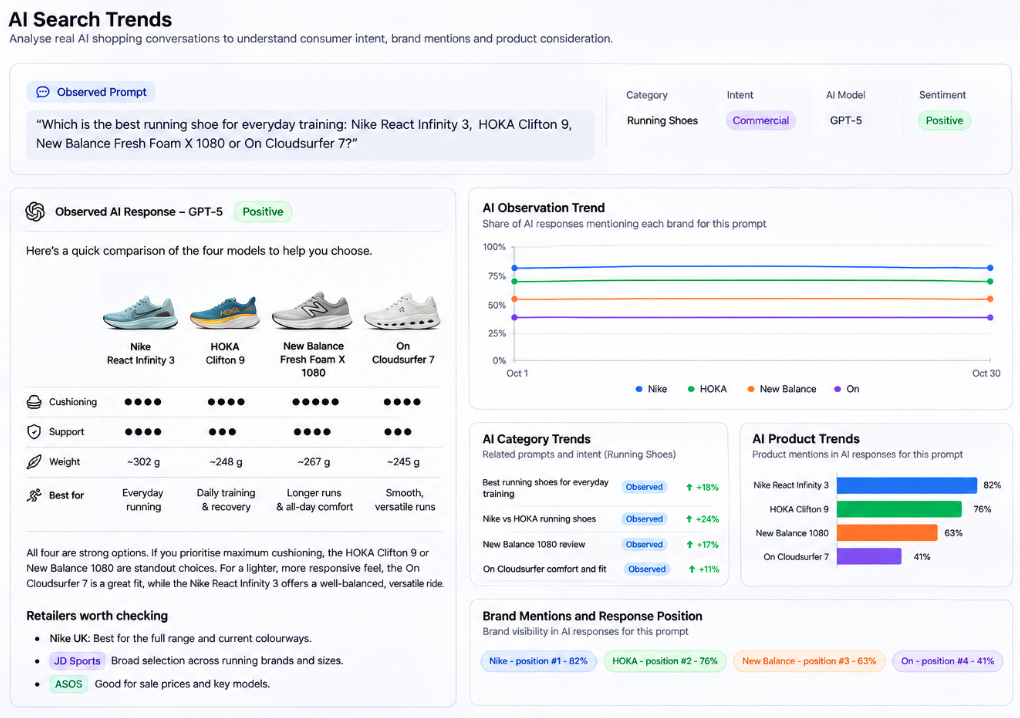
Why traditional ecommerce analytics are no longer sufficient on their own
Most retail organisations already operate multiple analytics systems.
- Performance marketing teams monitor campaign efficiency and ROAS.
- SEO teams track rankings, impressions and organic traffic.
- Merchandising teams analyse stock, sell-through, margins and assortment performance.
- Ecommerce leadership monitors revenue, conversion and customer acquisition.
Each system provides valuable information. But these systems may not reveal which products AI assistants recommend, how competing retailers appear in shopping conversations or which product attributes influence the comparisons being presented.
This creates three challenges.
1. Incomplete visibility into consumer evaluation
A retailer may know which products generated traffic without knowing how those products were represented during AI-assisted research.
2. Limited competitive context
Internal analytics explain what happened within the business. They do not necessarily explain whether competitors are being recommended more frequently for relevant shopping questions.
3. Fragmented commercial priorities
SEO may prioritise rankings. Paid Search may prioritise ROAS. Merchandising may prioritise margin and stock.
Without a shared view of external demand and competitive visibility, teams can optimise their own metrics without addressing the broader commercial opportunity.
What AI-assisted buying means for footwear, clothing and accessories retailers
The implications become clearer when we examine practical retail use cases.
Use case 1: Your products are missing from AI shopping recommendations
A UK footwear retailer stocks several popular running shoe models. However, its products rarely appear in sampled AI responses to relevant consumer questions.
The retailer needs to investigate whether the issue involves product relevance, content quality, brand visibility, retailer recognition or the specific prompts being measured.
Use case 2: Competitors dominate product comparisons
A shopper asks an AI assistant to compare two popular trainer models. The response repeatedly references competing retailers.
The ecommerce team needs to understand which products are being compared, which attributes matter and whether its own product pages adequately address those consumer questions.
Use case 3: Consumer demand exists, but your retailer is underrepresented
Search interest in a particular footwear category is growing. Competitors are gaining visibility. AI shopping responses increasingly feature relevant products. Yet the retailer’s own performance remains weak.
The problem may not be demand. It may involve product coverage, discoverability, availability or conversion barriers.
The five metrics retailers should investigate
Traditional search performance should now be complemented by AI-specific intelligence.
1. AI recommendation rate
How frequently is a brand, retailer or product recommended across a defined sample of relevant shopping prompts? This helps distinguish recommendation visibility from simple brand mentions.
2. AI share of voice
What proportion of relevant observed AI responses include your brand compared with selected competitors? Results should be interpreted within the specific prompt sample, provider, market and observation period.
3. Product-level recommendation coverage
Which product models, categories and attributes appear in AI shopping responses? This helps teams investigate whether recommendations align with the products they sell.
4. AI citations and sources
Which websites and sources are referenced in AI-generated answers? Citation analysis can help teams investigate the information sources associated with particular recommendations.
A citation is not the same as a recommendation, and neither guarantees a sale.
5. Search demand and competitive visibility
How do AI recommendation patterns compare with traditional search demand and retailer visibility? This is where AI search intelligence becomes more useful for commercial decision-making.
A product may have substantial consumer search interest but limited representation in sampled AI shopping recommendations. That difference can justify further investigation.
A practical operating model: Measure, Plan, Act
Retailers do not necessarily need to replace their existing analytics tools. They need a more connected approach to interpreting the market.
Measure: Understand what is changing
Bring together relevant signals from search demand, competitive visibility, product listings, internal performance and AI shopping responses.
Investigate where products are visible, where competitors are gaining attention and where important gaps exist.
Plan: Prioritise commercially relevant opportunities
Not every missing AI mention deserves investment. Teams should evaluate opportunities based on consumer relevance, product availability, business priorities, competitive evidence and the likely value of improvement.
For example, improving visibility for a product that is unavailable or commercially unattractive may not be a sensible priority.
Act: Align execution and accountability
Once the evidence supports an opportunity, teams can determine the appropriate response. That may involve improving product descriptions, strengthening category content, reviewing assortment coverage, updating product information or addressing technical discoverability.
Assign clear ownership and establish measurable success criteria.
The goal is not simply to increase AI visibility metrics. It is to improve how the business competes for relevant consumer demand.
How Cuebee Labs supports AI-assisted retail intelligence
Cuebee Labs is designed to help footwear, clothing and accessories retailers investigate the relationship between consumer demand, competitor visibility, product intelligence and AI-powered shopping discovery.
Its relevant analytical areas include:
- AI Search Trends
- Investigate shopping-related prompts and emerging AI search themes.
- AI Visibility
- Examine observed visibility across supported AI providers.
- LLM Mentions
- Investigate retailer and product mentions, recommendations and citations.
- Search Trends
- Understand traditional search demand across brands, products and categories.
- Product Performance
- Examine relevant product and retailer evidence.
- Benchmark Comparison
- Investigate competitive visibility across selected retail domains.
The purpose is to help ecommerce, merchandising and marketing teams work from a more connected view of the market.
Individual insights depend on the available data, supported providers, collection coverage and freshness of the underlying evidence.
Three priorities for ecommerce leaders heading into 2027
Look beyond owned-channel analytics
Your internal data remains essential, but it should be interpreted alongside external market demand and competitive visibility.
Plan beyond the first click
Product discovery increasingly includes conversational comparison, evaluation and validation. Retailers should investigate how their products are represented throughout those interactions.
Build one shared growth agenda
SEO, Paid Search, merchandising, ecommerce and content teams need aligned priorities. The objective is not to optimise every metric independently.
It is to identify which actions are most likely to improve commercially relevant product discovery and customer experience.
The opportunity ahead
AI-assisted buying is changing how consumers research products, compare alternatives and build confidence before making purchasing decisions.
But the transition does not make traditional search, retailer websites or human judgement irrelevant. It makes the connections between them more important.
Retailers that understand how consumer demand, competitive visibility and AI recommendations interact will be better equipped to identify emerging opportunities and make informed investment decisions.
The next competitive advantage may not come from appearing in more searches.
It may come from understanding which products consumers are considering, why those products are recommended and what your business needs to do to earn a place in that consideration set.
Frequently asked questions
- What is AI-assisted buying?
- AI-assisted buying is the use of artificial intelligence to help consumers research, compare, evaluate or select products. It may involve product recommendations, feature comparisons, review summaries and purchase guidance.
- How is AI-assisted buying different from traditional search?
- Traditional search commonly presents links and other search features for users to explore. Conversational AI can synthesise information, compare alternatives and answer follow-up questions within an ongoing interaction.
- Why does AI search visibility matter for ecommerce retailers?
- AI search visibility helps retailers understand whether their brands and products appear in relevant AI-generated shopping responses. It can reveal potential discoverability gaps not fully represented by conventional website analytics.
- Can retailers measure AI product recommendations?
- Retailers can analyse sampled AI responses to measure recommendation frequency, brand mentions, citations and product coverage. These metrics depend on the selected prompts, providers, locations and observation periods.
- Does AI visibility guarantee increased ecommerce revenue?
- No. AI visibility is an indicator of potential exposure or consideration, not a direct measure of sales. Revenue outcomes also depend on product relevance, pricing, availability, trust and conversion.
- How can retailers improve AI-assisted product discovery?
- Retailers can investigate relevant consumer questions, improve the accuracy and completeness of product information, strengthen useful category content, address technical accessibility and monitor how their products appear in sampled AI responses.

Geraldine N.
Author · Cuebee Labs
- AI Search
- Retail Intelligence
- Ecommerce Growth
Understand how AI is changing your retail market
Discover how consumers search for products, which competitors are visible and where your business may be missing opportunities. Explore Cuebee Labs and start your 7-day free trial.
Research references
- McKinsey & Company — AI to browse but not to buy, April 2026.
- Gartner — Consumers Want AI Shopping Help, But Not AI Purchase Decisions, May 2026.