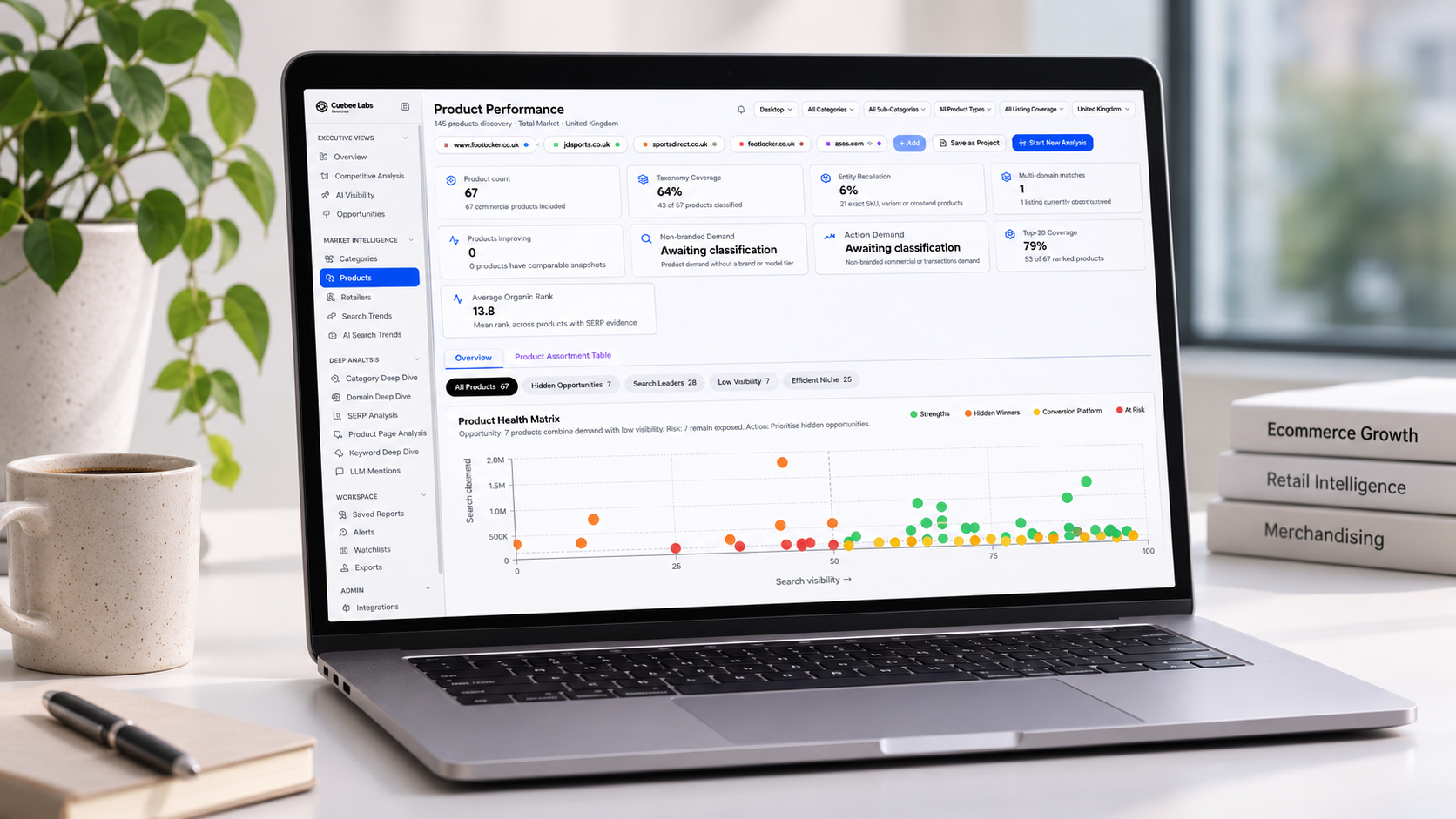
For ecommerce, merchandising and digital marketing teams, understanding the difference between weak market demand and uncaptured demand can change how they allocate budgets, manage product assortments and prioritise growth opportunities.
When declining sales tell only half the story
Imagine sitting in a weekly ecommerce trading meeting.
Running footwear is under pressure.
The paid search team has invested heavily in several trainer models, but performance is falling short of expectations.
Merchandising wants to shift investment towards products with better availability and stronger margins.
The SEO team is reporting changes in organic visibility.
Everyone has data. Everyone has a reasonable explanation.
But nobody can confidently answer the most important question:
Are consumers buying fewer running shoes, or are we losing the opportunity to sell them?
Too often, the meeting ends with a familiar conclusion:
“Demand is weak.”
It's a convenient explanation. It may also be the wrong one.
Because a product that isn't selling and a product that consumers no longer want are two very different things.
Weak demand vs uncaptured demand: What's the difference?
- Weak demand
- occurs when consumer interest in a product or category is genuinely declining.
- Uncaptured demand
- occurs when consumer interest exists, but a retailer fails to attract or convert its share of that demand.
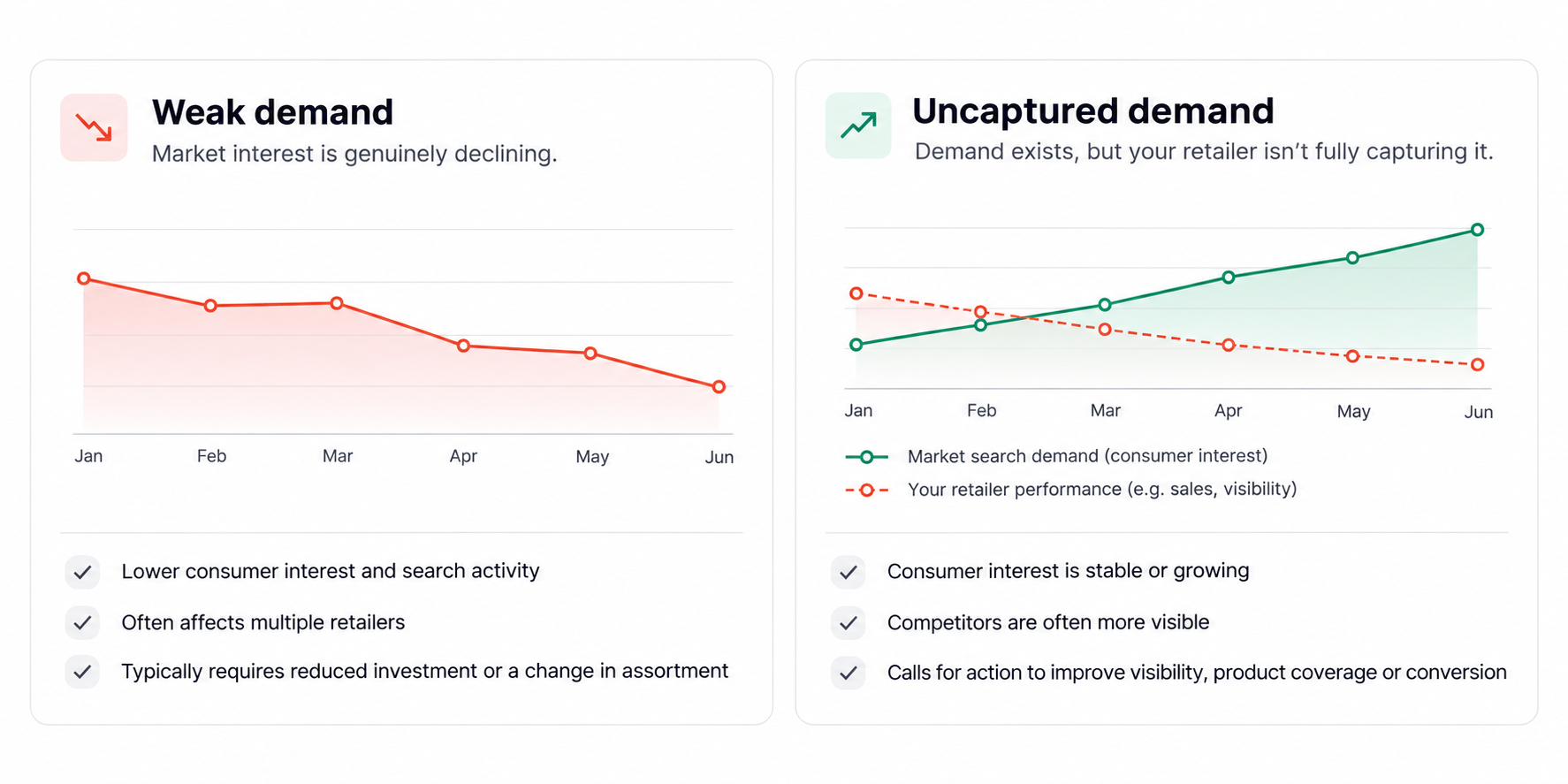
The distinction matters because each problem requires a different commercial response.
| Attribute | Weak market demand | Uncaptured demand |
|---|---|---|
| Consumer interest | Declining or limited | Present or growing |
| Search demand | Often falling | Stable or increasing |
| Competitor visibility | May decline across the market | Competitors may remain highly visible |
| Product availability | May not be the main constraint | Missing or unavailable products may contribute |
| Appropriate response | Reassess investment and assortment | Investigate visibility, product coverage and conversion |
| Commercial risk | Investing in a shrinking opportunity | Abandoning an opportunity competitors are capturing |
A retailer experiencing weak demand may need to reduce exposure, reconsider buying commitments or redirect marketing investment.
A retailer experiencing uncaptured demand may need to improve product visibility, address assortment gaps, strengthen category pages or investigate conversion barriers.
Treating both situations as the same problem can lead to precisely the wrong decision.
Why ecommerce teams often misdiagnose demand
Most retailers don't suffer from a lack of data.
They suffer from fragmented evidence.
Each department sees the market through the metrics it is responsible for improving.
Paid Search sees campaign efficiency
The performance marketing team monitors ROAS, cost per acquisition, click-through rates and conversion performance.
When campaigns underperform, the instinct may be to reduce spend or redirect budgets towards products with stronger recent returns.
But declining ROAS doesn't necessarily mean consumer demand has disappeared.
The problem could involve higher acquisition costs, weaker product availability, changes in competitive visibility or conversion issues.
Merchandising sees sales, stock and margin
Merchandising teams focus on sell-through, stock availability, product profitability and inventory exposure.
When a trainer model underperforms, the logical response may be to reduce future buying commitments or prioritise products with stronger margins.
But internal sales data alone cannot establish whether demand is declining across the wider market.
A product might be underperforming because consumers are finding and buying it elsewhere.
SEO sees search visibility
SEO teams examine rankings, impressions, organic traffic and search performance.
They may identify lost rankings or reduced visibility for important product searches.
However, search performance alone doesn't always explain whether the underlying issue is product availability, assortment coverage, content relevance or changes in consumer preference.
Leadership sees competing explanations
The Head of Ecommerce or Digital Director must decide where to allocate resources.
Paid Search recommends one action. Merchandising recommends another. SEO identifies a different problem.
Each team may be correct within its own dataset.
The missing piece is a shared view of what consumers want, where competitors are capturing attention and how the retailer is positioned to respond.
A practical example: The running footwear category
Consider a hypothetical UK multi-brand footwear retailer.
Sales of a particular running shoe model have declined.
The paid search team recommends reducing investment. Merchandising is considering shifting inventory commitments towards another product.
Before making that decision, the retailer investigates external market signals.
| Market signal | Observation |
|---|---|
| Internal product sales | Down 18% year over year |
| Consumer search demand | Up 12% year over year |
| Organic search visibility | Retailer's visibility declining |
| Competitor visibility | Two competing retailers gaining visibility |
| Product assortment | Popular colourway missing from the retailer's catalogue |
| Stock availability | Several sizes unavailable |
The numbers are illustrative, but the decision-making problem is realistic.
If consumer demand is increasing while the retailer's sales are declining, the team has a reason to investigate whether it is losing share of the available opportunity.
That does not prove competitors are converting the demand or establish why sales have fallen.
It does, however, challenge the assumption that the market has simply lost interest.
Instead of immediately reducing investment, the team can investigate product availability, search visibility, competitor assortment and conversion performance.
The resulting decision may be very different.
Five signals that help distinguish weak demand from uncaptured demand
1. Consumer search demand
Are consumers still searching for the product, brand, model or category?
Search trends can help establish whether interest is increasing, declining or shifting towards alternatives.
For example, falling demand for one trainer model alongside growing demand for a newer generation may indicate a change in consumer preferences.
2. Competitor search visibility
Are competing retailers gaining visibility for the same product searches?
If your website is losing organic visibility while competitors remain prominent, the problem may involve competitive positioning rather than market demand alone.
Search visibility should be evaluated within a consistent market, query set and observation period.
3. Product assortment coverage
Does your retailer stock the products and variants consumers are looking for?
A retailer might carry a popular footwear model but lack relevant colourways, sizes or product variations.
Those gaps can limit its ability to capture available demand.
4. Pricing and stock availability
Are shoppers encountering unavailable products, missing sizes or uncompetitive prices?
Even when consumer interest is strong, stock and pricing conditions may prevent a retailer from converting that interest into sales.
Competitor pricing and availability evidence can provide useful context, although these signals must be checked for freshness.
5. AI-powered product discovery
Are AI shopping assistants recommending competing brands, models or retailers?
Consumers increasingly use conversational AI to compare products and investigate purchasing options.
Retailers can examine sampled AI shopping responses to understand which products and retailers appear for relevant consumer needs.
These observations provide an additional discovery signal, although they do not establish actual sales or conversion outcomes.
What changes when retailers identify the real constraint?
Distinguishing weak demand from uncaptured demand can improve decisions across the buying committee.
For Ecommerce Directors: Protect potential revenue
When demand exists but the retailer is underperforming, the priority becomes understanding which constraints are limiting growth.
That might involve improving category visibility, resolving availability issues or addressing product coverage gaps.
For Merchandising Teams: Make more informed assortment decisions
Merchandising teams can compare internal sales performance with external product demand and competitor listings.
This can help distinguish products facing genuine market weakness from products that may be underrepresented or poorly supported.
For Performance Marketing: Allocate spend more intelligently
Understanding changes in market demand and competitive visibility can help marketing teams investigate whether campaign underperformance reflects weaker demand or other constraints.
For SEO Teams: Prioritise commercially relevant visibility gaps
Search opportunities become more useful when connected to the products and categories the business can actually sell.
Rather than optimising solely for keyword volume, teams can investigate where demand, product relevance and competitive visibility intersect.
For Leadership: Build a shared commercial fact base
The greatest benefit may be organisational.
When teams use consistent market evidence, trading meetings can move beyond competing departmental explanations.
The discussion becomes less about defending individual metrics and more about identifying the actual constraint on growth.
How Cuebee Labs helps retailers investigate uncaptured demand
Cuebee Labs is a retail market and competitive intelligence platform designed for footwear, clothing and accessories businesses.
It connects external market signals to help teams investigate where consumer demand exists, how competitors are positioned and which opportunities may deserve attention.
Relevant capabilities include:
- Search Trends
- Investigate consumer demand across relevant products, brands and categories.
- Benchmark Comparison
- Compare competitive search visibility across selected retailers.
- Category Deep Dive
- Examine category-level demand and competitive performance.
- Product Intelligence
- Investigate product assortment, available variants, pricing and retailer listing evidence.
- AI Visibility
- Examine observed AI shopping mentions, citations and recommendations where supported by the enabled providers.
The objective isn't to replace internal sales, advertising or analytics systems.
It's to provide additional market context that helps teams interpret their own performance more effectively.
A better question for your next trading meeting
When a product or category begins to underperform, resist the temptation to accept the first explanation.
Instead, ask:
“Is demand actually declining, or are we failing to capture demand that already exists?”
Then investigate the evidence:
- Is consumer search interest increasing or decreasing?
- Are competitors gaining visibility?
- Are we missing relevant products, models or variants?
- Could pricing or availability be limiting performance?
- Are shoppers discovering competing products through search or AI recommendations?
The answer may justify reducing investment.
It may also reveal an opportunity worth protecting.
Either way, the decision should be informed by what is happening in the market, not simply what is happening inside your own reporting systems.
Frequently asked questions
- What is uncaptured demand in ecommerce?
- Uncaptured demand is existing consumer interest that a retailer fails to attract or convert into sales. It may result from limited search visibility, assortment gaps, unavailable products, pricing differences or conversion barriers.
- How can retailers tell whether demand is declining?
- Retailers can compare internal sales performance with external search demand, competitor visibility, category trends and product availability. No single metric establishes the full explanation, so multiple signals should be evaluated together.
- Can sales decline while consumer demand increases?
- Yes. A retailer's sales can decline even when wider market demand is growing. This may occur when competitors gain visibility, product availability weakens, consumer preferences shift or the retailer loses conversion efficiency.
- How can competitor intelligence help identify missed revenue opportunities?
- Competitor intelligence can reveal where other retailers have stronger visibility, different product assortments or more favourable availability. Combined with consumer demand data, these signals help teams investigate opportunities their business may be missing.
- Does increasing search demand guarantee higher sales?
- No. Search demand indicates consumer interest, not confirmed purchasing behaviour. Revenue outcomes also depend on product relevance, availability, pricing, conversion performance and other factors.

William S.
Author · Cuebee Labs
- Retail Market Intelligence
- Ecommerce Strategy
- AI Search
Stop guessing why your category is underperforming
Understand what consumers are searching for, how competitors are positioned and where your retail business may be missing opportunities. Explore Cuebee Labs and start your 7-day free trial.